NORFED Liberty Dollar Newsletter - August 2002
LIBERTY DOLLAR NEWS: August 2002 VOL. 4 NO.8 IMPORTANT: Please read Article #1 and #2 - VERY IMPORTANT NEWS
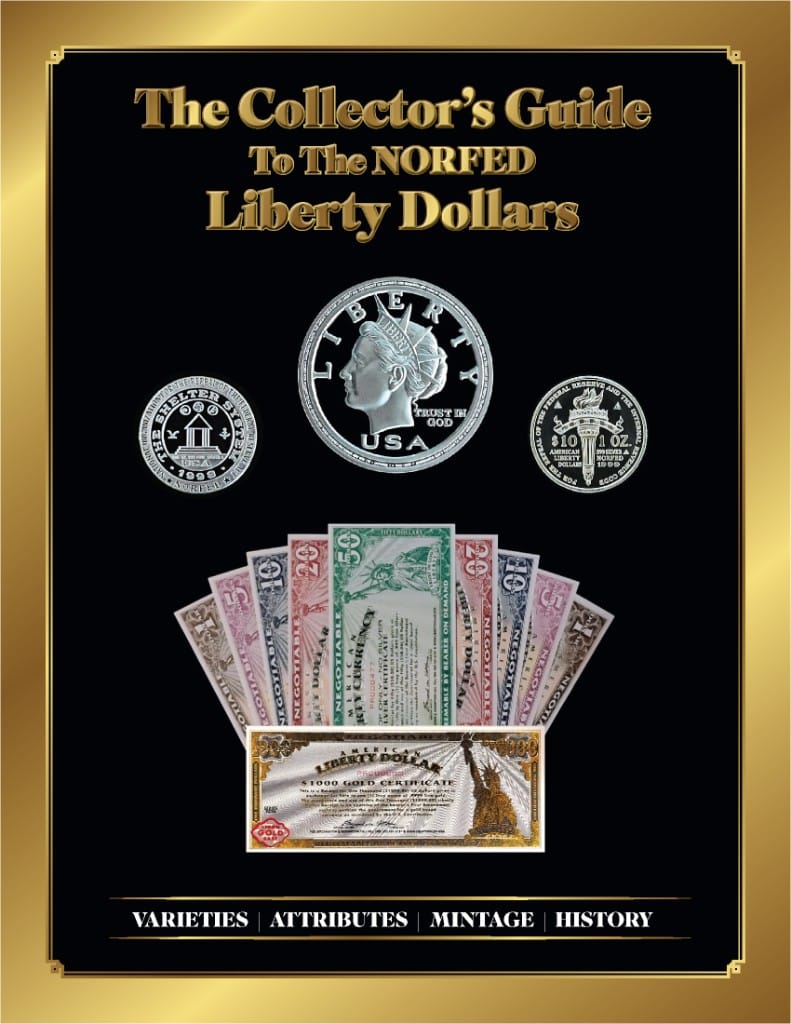
- IMPORTANT: Gold and Silver Libertys are NOT… Now, I would hope by this time that everybody knows the Gold and Silver Libertys are not "legal tender", nor are they "coins", as a "coin" is something issued by a government, and we are not they, nor do we ever want to be. The fact that the “Libertys” cannot be described with these terms has been enshrined in the United States Code, so it is not just numismatic, it is the law. And as the government also defines "money" and "current money", the Gold and Silver Libertys are neither of these. As part of our ongoing legal and monetary research, we recently reviewed USC Title 18, Section 486. Dating from the time of the War Between the States, Section 486 was originally known as the Act of June 8, 1864 . It came about shortly after the first legal tender laws were passed, which ushered in Lincoln 's fiat "greenback" currency and drove all specie out of circulation. The Act was revised in 1873, 1909 and 1948. The current statute states: Section 486: Uttering coins of gold, silver or other metal Whoever, except as authorized by law, makes or utters or passes, or attempts to utter or pass, any coins of gold or silver or other metal, or alloys of metals intended for use as current money, whether in the resemblance of coins of the United States or of foreign countries, or of original design, shall be fined not more than $3,000 or imprisoned not more than five years, or both. June 25, 1948 , c. 645, 62 Stat. 709. Upon careful review of all cases pertinent to Section 486, it is the opinion of our lead attorney that the NORFED Gold and Silver Libertys are not in conflict because they are not "coins," nor are we circulating them as "money" as defined by the government. So we must continue to refrain from referring to Gold and Silver Libertys as "coins", "money" or "currency". We can continue to refer to The Liberty Dollar as "money" and/or "currency" because Section 486 only applies to metal; it does not apply to paper warehouse receipts, nor digital currencies. In fact, Section 486 actually reinforces our original position on these two items. Based on independent legal research and the Legal Opinion Letter by our lead attorney, Section 486 is largely based on "intent". So upon advice of counsel, NORFED hereby issues this disclaimer to officially define the intent of the Gold and Silver Libertys, as we have no intent to be in conflict with federal law. Please note the Disclaimer that follows and which is now posted on the NORFED web
site. Disclaimer: Gold and Silver Libertys are neither legal tender, money, "current money" nor coins; they are not minted, issued or approved by any government agency; do not generally circulate; are not intended to circulate; and do not relate to taxation or avoidance of taxation. They are privately minted one-ounce gold and silver examples of the goods on deposit for the NORFED warehouse receipts. Henceforth, all Gold and Silver Libertys will be provided with the clear understanding that it is NORFED's intent that all Gold and Silver Libertys are only examples of the goods on deposit for the NORFED warehouse receipts. Of course, what you and thousands of other freedom loving, consenting adults choose to do in response to the government's fiat money is beyond NORFED's ability or duty to police. Furthermore, all new Gold and Silver Libertys will carry the NORFED URL and phone number to further brand them as advertising specialty items and examples only. Please note that in keeping with our defensive position, NORFED does not disclose any legal research nor Legal Opinion Letters. Of course, you are welcome to do your own research, and we would welcome a copy of your findings relative to our common goal. 2. Almost as important: Missing Newsletters We have just discovered that the web site is missing seven early Newsletters. The worst part is that with computer failures, etc. we cannot find back-up copies. If you have any Newsletters from December, 1998 through June, 1999 please contact the NORFED office via [email protected] or call: 888.421.6181. It is very important that we find these critical records of our first year. Thank you taking a look. 3. Four Page Insert in Maine Commons As we reported last month, The Maine Commons newspaper did a major article on the Federal Reserve and The Liberty Dollar. In celebration of Dale McAvey’s 200+ Liberty Merchants in Maine alone, the outstanding efforts of Bob Keith RC/PA, and a great deal from the Maine Common folks; the September 8 issue of the Maine Commons will carry a four page, center fold, insert! The insert features seven different articles, including one on Redemption Centers, Liberty Merchants,
Community Currency, The Maine Model, Debt & Inflation and others. All the articles have been carefully orchestrated to explain the different parts of the Liberty System so that it will be another educational tool that is easy to read and quick to get the attention of anyone who is looking for a solution. Laid out like a newspaper with a new LIBERTY DOLLAR TIMES masthead, the four-page insert lists all 200+ Liberty Merchants. The tabloid size insert, which measures 23 inches by 13-1/3 inches, will have a 10,000 circulation through out Maine . “The Maine Model” article not only covers what is happening in the great, but often forgotten state of Maine, the article presents a model for what you can do in your area. And to help you duplicate Dale’s success in your own backyard, we had 10,000 extra copies printed. The four-page insert is available on a first come, first serve basis for only ten cents each plus a $2.00 flat fee for shipping. This is a great tool to share with your friends who have questions and need more info. Please email your order to [email protected] with the word “INSERT” in the subject field or you can down load it from the internet at: www.libertydollar.org/press/maineinsert.pdf. 4. Digital Warehouse Receipt Editor note: This article comes to you in preparation for the new digital Liberty Dollar which is rushing towards completion. Please stay tuned, it should not be much longer… A Digital Warehouse Receipt is much like a paper warehouse receipt, but better A warehouse receipt is a contract between a warehouse and another party, individual, or bearer. Like every contract, there are a number of elements required for it to qualify as a legal, binding agreement. The Uniform Commercial Code (UCC), the governing body of law for warehouse receipts (original paper), specifies seven such elements: 1) Term of receipt, 2) Date of issue, 3) Description of item warehoused, 4) All additional charges or conditions, 5) Expiration of receipt, 6) Address of warehouse, 7) Signature of the warehouse official. All seven elements must be on the paper warehouse receipt. Whereas Digital Warehouse Receipts (DWR) have been issued by Sunshine Minting, Inc. to NORFED in paper form with the seven elements, NORFED can now distribute DWR in digital form with all of the same elements and terms intact. Just as it is legal to use your digital signature to "sign" documents, it is now legal for you to use DWR as defined by the Terms of Service on the web site. Digital Warehouse Receipts are different from paper warehouse receipts in that any part can be fractionalized to thousandths of the whole. And because of the digital nature of a DWR, this fractionalization can be executed by the bearer on demand, so long as the whole never exceeds the quantity of the underlying goods in the warehouse. All Liberty Dollars in digital form (ALD) are backed by silver at a $10 base, which means that every ten dollars ($10) is backed and redeemable by one Troy ounce of .999 fine silver.
Strict measures have been taken to safeguard the integrity of the digital Liberty Dollar (ALD) and bar it from the type of fraud that the current banking scheme represents. First, the software has been designed so NORFED never distributes more currency than that allowed by the paper warehouse receipts received from Sunshine Minting, Inc. Second, a Daily Transaction Report (DTR), which is automatically generated, records the total daily balance of digital Liberty Dollars in the ALD system. Without identifying any individual accounts, individual activity or invading anyone’s privacy, the DTR provides the monthly auditor the means to verify that the Liberty System is always 100% backed and 100% redeemable - just like The Liberty Dollar in paper form. Third, the independent auditor's certified monthly report is posted for review at: /Audit_Monthly.asp. Digital Warehouse Receipts provide numerous advantages, just as your digital signature provides advantages in our advancing digital age. In addition to the speed, safety and the flexibility that fractionalization provides via digitalization, the ALD can also be used in e-commerce on the Internet. Plus, it can be e-mailed in total privacy to anyone in the world, even if they don't have an ALD account. Just as you can send an e-mail at a fraction of the cost of a regular long distance phone call, ALD costs only $0.37 per transaction, and no charge on transactions less than $10. The best part of the digital Liberty Dollar is not that it costs much less, but that you can earn more. These savings are passed on to you in the form of greater discounts and larger referral fees. Whereas paper warehouse receipts require paper, printing, special security and counterfeit features, storage, transportation, signing, counting and all of the usual administration fees, the DWR does not require any of these. So the discount and referral fees on all sponsoree exchanges from those dreaded FRNs into ALDs are doubled to a 10% discount, and also to a 10% referral fee. Plus $0.10 per sponsoree's transaction. What this all means is that if you sponsor just one person who uses the same amount of digital Liberty Dollars on a monthly basis as you do, you will effectively be getting 20% on your money plus all the dimes on the sponsoree's transactions. If you sponsor just 9 friends who use the same amount of digital Liberty Dollars monthly, you will be getting your money for free! And if you sponsored 100 friends, you would be living for FREE!! Today marks a turning point in monetary history. The new digital warehouse receipt is a moral, legal, and Constitutional contract between the bearer and NORFED, as defined by the Terms of Service and verified by an independent physical audit. Now is the time to sponsor more people to return America to value - one Liberty Dollar at a time. 5. Yellow Page Directory also Available Ever have trouble finding a Redemption Center or Liberty Merchant and have to scroll through an increasing number of people? Well, I have! And how about searching for the Liberty Merchant who has the Goods and Services that you want? Me too! We are all looking for the same things. And now you can find all of them and more at Yellow Page Directory. Simply click on the Yellow Page Directory button on the Home Page and search by state for any of these objectives. And now you can search by person. Check it out by doing a search on yourself, and then be sure to update the info in your RC and LM file. Remember, when searching for Goods and Services, the computer searches on
the word or phrase in the memo fields. Please update the words in your memo field so people can find you and use real money for your Goods and Services. 6. Penicillin Marketing During the past couple of years, one of the hottest marketing terms has been "Viral Marketing." Simply based on how the common cold spreads from person to person, Viral Marketing spreads the same way. Once you are "infected" with an idea or product, the marketer hopes it will spread like the common cold. No one is safe! And although the connotation of a virus is bad, the analogy is good and hence it is good for marketing. But I don't think we should use a negative phrase to describe a positive marketing concept, so I have coined the term Penicillin Marketing to describe how The Liberty Dollar works. Just as penicillin is introduced into the body, we have introduced The Liberty Dollar into the near comatose American body. And like the good antibiotic that it is, it cannot been seen. It cannot be stopped. It simply circulates throughout the body and kills the bacteria until the person is well. The Liberty Dollar works the same way. Widely distributed but rarely seen, it just continues to attack the fiat money bacteria until the American publica is well. So when you need a phrase to describe how The Liberty Dollar works, or its marketing, use Penicillin Marketing. Spread it around. A good dose of The Liberty Dollar is the only antibiotic that I know that will cure what ails our country and its money. 7. Bob Schulz's call for unity On February 27, 2002, Bob Schulz called for all Liberty organizations to stand together and have a free dinner. Well, I was not available for the dinner, nor was I able to be in Washington on short notice, but I would like to think that NORFED and The Liberty Dollar fits the bill. But I still did not act. And now finally after subsequent postings by Bob, I have joined his We The People Congress for $100, and ask you to give careful consideration to doing the same. As our Founding Fathers knew, if we don't hang together, we will certainly hang separately. Here is just one of Bob's many posts which have convinced me to take action: An Appeal to Every Organization That Stands For Liberty The Time Has Come For Us to Stand Together I am writing this letter to ask for your help. As you may know, We The People Foundation For Constitutional Education, Inc. has been working diligently for years to expose the grave danger that bloated, wasteful and out-of-control government poses to our unalienable rights as Americans. This appeal is being sent to the leaders of every major organization that is fighting to defend our Constitution and Bill of Rights, and ultimately, the very survival of our Republic. Who can deny that we have reached a critical juncture in the life of our Country? The size, scope and power of the federal government have become so vast that virtually every aspect of our lives is
monitored, regulated, documented and controlled. We are asking those organizations, like yours, that have been courageously leading the fight for freedom and the return to our nation's founding principles, to now stand together and speak with a common voice. Notwithstanding our different and sometimes competing missions, we must acknowledge that divided and separate, we will never achieve the critical mass or the momentum required to restore our rightful liberty. We must acknowledge that academic rhetoric and abstract political debate have failed to hold our servant government in check. This is an appeal to all patriotic organizations across our nation that stand guard over the flame of liberty. We ask that you join us in this unprecedented effort to bring all major freedom organizations together with a common focus and purpose…to restore the authority of the United States Constitution and Bill of Rights as the foundation for our system of government in America. We The People Foundation would like to invite you and your senior representatives to be our guests at a private dinner and informal discussion session on February 27, 2002, at 6:00 p.m., at the Washington Marriott Hotel. We will have a guest dinner speaker, and afterwards conduct an open discussion of how freedom organizations can work together to create a powerful and effective force for liberty that is greater than the sum of its parts. How many of our unalienable rights have already been completely lost or seriously eroded by an overreaching and power-hungry federal government? The right to privacy The right to property The right to a public trial The right to a speedy trial The right to a trial by a jury The right to due process of law The right to a fully informed jury The right to keep and bear arms The right to freedom from vote fraud The right to freedom from taxes on wages The right to a republican form of government The right to a politically independent judiciary The right to freedom from involuntary servitude The right to confront the witnesses against you The right to freedom from government acts not enumerated The right to freedom from searches without probable cause The right to a monetary system backed by a precious metal The right to petition the government for a redress of grievances The right to freedom from laws that favor public over private education The right to freedom from being forced to be a witness against yourself The right to freedom from searches and seizures without proper warrants
The right to freedom from the "same hands" controlling all three branches The right to freedom from having property taken without just compensation The right to freedom from federal laws in areas outside of federal jurisdiction The right to freedom from the imposition of direct taxes not tied to the census The right to representation loyal to the constitution rather than to a political party The right to freedom from having an appeals court re-examine facts tried by a jury The right to freedom from the use of the armed forces without a declaration of war The right to freedom from constitutional amendments not ratified by ¾ of the States The right to freedom from the usurpation of the powers of the Congress by the Executive Now is the moment for those who deeply love our country, and what it truly stands for, to set aside their differences and unite in defense of our Constitution and rightful liberties as Americans. No single freedom organization in the country has the influence, resources or capability to stem the tide of government tyranny alone. But together we have the mass, the scale, and the power to bind our servant government down with the chains of the Constitution. We need only to find the courage to live the convictions of our hearts, the wisdom to look beyond the immediate obstacles in our path, and the confidence that the Master of the Universe will once again reward our vigilance with the blessings of liberty. Each freedom organization has its own mission, purpose and strategy. Whether the organization is devoted to the protection and preservation of our 2nd Amendment right to keep and bear arms, or our 1st Amendment right to petition our government for redress of grievances, the issue that ultimately ties us all together is the defense of our Constitution and Bill of Rights. If every freedom organization that usually concentrates on just one of the aforementioned rights decided to unite and focus on a single constitutional violation, consider the possibilities. The critical mass of influence would be overwhelming. WHY AM I REACHING OUT TO ALL LIBERTY RIGHTS GROUPS? As you may know, the Foundation is engaged in an extraordinary struggle to hold the federal government accountable to the First Amendment's guarantee of every citizen's right to properly petition the government for a redress of grievances and the government's obligation to properly answer. In our case the grievances relate to the constitutional and statutory authority of the IRS to force employers to withhold the income tax from the paychecks of their employees and the legal authority of the IRS to force most citizens to file a tax return and to pay the tax. The most probable outcome of the Foundation's success in this struggle will be a more constitutionally limited government--an objective that we all share. We do not expect any of the freedom organizations that are being invited to join us for dinner and discussion on February 27 to take a position for or against any of the propositions relating to the fraudulently assumed jurisdiction of the IRS and the unlawful income tax system. We do, however, hope to achieve support for our position that Americans have a constitutionally protected right to petition our servant government for redress of grievances, and a right to demand that the government
respond openly and honestly to that petition, for without the right to petition the government for redress of grievances then, in practical effect, the people have no rights at all. While the leaders and members of all liberty, rights and freedom organizations are invited to register to attend the tax hearing on February 27 and 28 (it's free), we sincerely hope that a representative from each group will register to attend the special "UNITY DINNER" on February 27, which is also free of charge (although the Foundation would not turn any donations away ). For more information on the Foundation and our Petition for Redress of Grievances relating to the federal power to tax, please visit our website, www.givemeliberty.org. Please note that preferred registration status for the daytime tax hearing will be given to leaders and senior representatives of liberty rights organizations. Even if you choose not to attend, please consider the impact you may have by spreading the word of this initiative throughout your organization's membership. I look forward to seeing you in Washington. Robert Schulz Chairman We The People Foundation for Constitutional Education, Inc. 2458 Ridge Rd. Queensbury, New York 12804 (518) 656-3578 phone (518) 656-9724 fax www.givemeliberty.org [email protected] 8. "ALD - Forum" Chat Group Commences The first chat group for The Liberty Dollar is now open. You need not be a Redemption Center, Liberty Merchant or even a Supporter of The Liberty Dollar to join. In fact anyone who is interested in individual liberty and the means to secure it is welcome. The group provides an excellent way to get the basics and introduce your prospective RC or LM to The Liberty Dollar. Plus, you will certainly meet some like-minded individuals while building consensus towards a new monetary system based on value vs. fraud. Please join the Liberty Dollar chat group every Wednesday at 7:00 CST. Please sign up early and test drive the group if you are not familiar with chat groups, as we start promptly at 7:00 and only last as long as the chat remains lively…
Please feel free to post questions, comments, articles, suggestions, or anything else related to The Liberty Dollar to this group. The monitor is very knowledgeable about money, so you are sure to get the answer you're looking for. To learn more about the ALD Forum, please visit http://groups.yahoo.com/group/ALD-forum. To start sending messages to members of this group, simply send e-mail to ALD- [email protected]. If you do not wish to belong to ALD-forum, you may un-subscribe by sending an email to ALD-forum- [email protected]. To see and modify all of your groups, go to http://groups.yahoo.com/mygroups. Regards, The ALD-forum Team 9. Question of the month Question: When are sponsorship fees paid? Answer: Sponsorships Fees are immediately paid in five $20 Liberty Checks after the Sponsoree's initial order has been processed and shipped. Although we fill all new RC orders first, the sponsoree's payment must clear before the order is processed. Due to processing time, postage to NORFED office, and postage of the Liberty Checks to you, please allow up to 30 days from the time a new RC mails in his contract and funds. 10. Redemption Center of the Month Writes a Book Phil Hart has something before the Supreme Court and is sending in something, or go to Don Harkin's e-mail 7/1/2:17 PM… Constitutional Income: Do You Have Any? is a recently released groundbreaking work that defines the authority granted to Congress by the 16th Amendment. Author Phil Hart, who operates a Liberty Currency Redemption Center, dug through records found only in the Library of Congress and the Supreme Court’s law library and uncovered significant evidence that had not yet appeared in the literature. Author Hart also made an exhaustive search of other historical records in a effort to determine what the purpose of the American people was when they lobbied Congress for the income tax amendment to the Constitution. These sources included law journals, political economy and economic journals, newspapers, magazines, the Congressional Record and other congressional documents. Key to Hart’s research and conclusions were the complete Transcript of Record of the early income tax cases reaching the Supreme Court after the purported ratification of the 16th Amendment. The arguments made in these early cases appear in the briefs and court transcripts. The Court’s opinions, read in light of the full case record, make crystal clear the limited authority of the 16th Amendment.
When the Supreme Court ruled that the 16th Amendment created "no new tax," what they meant was that the original Constitution was still intact and unchanged. Only the theories one would use to determine what was or wasn’t a direct tax were affected by the 16th Amendment. Direct taxes must still be apportioned. Indirect taxes must still be uniform. Hart absolutely proves that taxes on the wages and salaries of American workers are direct taxes and required to be apportioned among the several States. According to Hart, "There is no income tax exception to the direct taxation clauses of the Constitution." The summation of the 428 pages of this work proves without question that "the purpose of the 16th Amendment was to bring tax relief to wage earners." Hart currently has a Petition for Writ of Certiorari before the Supreme Court, docket number 02-84, which makes the direct tax vs. indirect tax argument. Constitutional Income: Do You Have Any? May be purchased on the web at www.constitutionalincome.com 11. Quote of the Month "Beware the leader who bangs the drums of war in order to whip the citizenry into a patriotic fervor, for patriotism is indeed a double-edged sword. It both emboldens the blood, just as it narrows the mind. And when the drums of war have reached a fever pitch and the blood boils with hate and the mind has closed, the leader will have no need in seizing the rights of the citizenry. Rather, the citizenry, infused with fear and blinded by patriotism, will offer up all of their rights unto the leader and gladly so. How do I know? For this is what I have done. And I am Caesar." Julius Caesar 12. Silver” by David Morgan “ NORFED is fortunate to have the support of David Morgan, Precious Metals Analyst, simply one of the brightest writers on Silver, and of course a Redemption Center. If you have not read this recent article with its rich historical info (yes, it is a bit long…), then I encourage you to do so and then visit David's site at www.silver-investor.com for up-to- the-minute info. The Significance & Sanity of Silver as Money "We are completely dependent on the commercial banks. Someone has to borrow every dollar we have in circulation, cash or credit. If the banks create ample synthetic money, we are prosperous; if not, we starve. We are absolutely without a permanent money system. When one gets a complete grasp of the picture, the tragic absurdity of our hopeless position is almost incredible, but there it is. It is the most important subject intelligent persons can investigate and reflect upon. It is so important that our present civilization may collapse unless it becomes widely understood and the defects remedied soon."
- Robert H. Hemphill, Credit Manager of the Federal Reserve Bank, Atlanta, GA.
This article is about silver’s monetary role throughout history, though it should be read as an overview, since much more complete works exist on this subject. It is truly impossible to discuss silver as money without mentioning gold’s role as well. At times countries have been on a gold standard or a silver standard or a dual standard. My aim with this piece is to encourage readers to consider the role they believe silver has in today’s economy. Is silver a monetary metal? Is it an industrial commodity? Is it both? In this brief preface, two ideas are pertinent to all. First, the above quote from Robert Hemphill will be meaningful to you only if YOU give it meaning. To wit, only when you are able to prove to your own satisfaction that a debt-based monetary system poses no threat to your financial well being and will be able to endure through your children’s lifetime will you feel secure. Second, consider how you might protect yourself if you turn out to be wrong. In other words, if you were to allocate a mere 5% of your investment portfolio to silver, just how badly could you be hurt? Sure, if silver were to go to zero, you’d lose 5% of your total investment base – but, were silver to reach its former highs, your small allocation might prove a highly welcome asset in a not-so-certain world. With this background let us begin. Economists seem as a whole to be totally perplexed by money. Even free market economists usually insist that some sort of government control is needed for money. These same economists seldom consider that government control of money is interference in the free market! Historically, money was one of the first things controlled by government. In my opinion, however, the free market is best at determining money. Gold and Silver are Assets, Not Liabilities An argument often mentioned about gold is that it is the only asset that is not simultaneously someone else’s liability. This is fiction not fact. Silver, copper, iron, or even cotton, tobacco, or cornmeal would be able to perform the same function. In other words, nearly any commodity that is totally owned by someone is an asset and not a liability. Many different goods have been used as money throughout history. Throughout centuries, only two commodities, gold and silver, have emerged as money in the free competition of the market, and have displaced the other commodities. In a free market, the medium of exchange is developed by people and their economic interactions. This is what establishes what money is. It is not established by a government calling bits of paper “money.” A most important truth is thus established, MONEY IS A COMMODITY! “Learning this simple lesson is one of the world’s most important tasks. So often have people talked about money as something much more or less than this. Money is not an abstract unit of account, divorceable from a concrete good; it is not a useless token only good for exchanging; it is not a ‘claim on society’’; it is not a guarantee of a fixed price level. It is simply a commodity. It differs from other commodities in being demanded mainly as a medium of exchange.” 1
The shape of the money unit makes no difference. If copper is the money, for example, then all copper is money, whether it is a pipe, chunk, bar, coin, or picture frame. This is not to say that some shapes are not more convenient than others. The free market will determine if a coin is to carry a premium over another form of the same metal. Another area that can be simplified is the money supply question. It cannot be estimated how much effort has been devoted, and nonsense has been written, on this subject. The question is really how much money does the world need? Can the free market determine the correct amount of money? For illustration let us use one commodity established by the free market as money. For this example I will use silver. The first point is that the money supply is the total weight of silver existing. Changes in the money supply would be determined by the same factors as with other goods. Increases would come from increased mined supply, and decreases from its being used up by wear and tear, industry, or loss. So, what should the money supply be? Only a few have suggested the obvious - let the market itself decide. Money Is Different Money differs from all other commodities, and this difference must be fully understood. When the supply of any other good increases, this is beneficial as more goods mean an increased standard of living. Consumer goods are used up, capital goods are used up, but money is not used up. Its function remains, and it is still available for further transactions. Let us suppose for example that we were able to double the money supply (amount of silver). Would we be twice as rich? Absolutely not. What makes one rich is an abundance of goods. What limits that abundance is a scarcity of land, labor, or capital. Thus, an increase in the supply of silver only dilutes the worth of each ounce, whereas a fall in supply raises the power of each silver ounce to do its work. “We come to the startling truth that is does not matter what the supply of money is. Any supply will do as well as any other supply.”2 The free market will simply adjust by changing the purchasing power or effectiveness of the silver unit. Gold is mentioned first in the Bible. The first reference I could find to money was in Genesis 44:8 – “Behold, the money, which we found in our sacks’ mouths, we brought again unto thee out of the land of Canaan: how then should we steal out of thy lord’s house silver or gold?” The first monetary transaction recorded in the Bible is also in Genesis. Abraham weighs 400 shekels of silver to pay for his wife’s burial. This is the same Abraham all three major religions of the world express as a link to the God in which they believe. Judaism, Christianity and Islam all refer to the “God of Abraham.” This reference to silver in Genesis applies universally, across cultures, and throughout the ages. Silver has had a monetary function far longer than gold, being used as the most common medium of exchange in everyday commerce since well before the time of Christ. In this article, my aim is to promote an understanding that silver retains a vital monetary purpose and is, in fact, more crucial to mankind that ever before. This is true both financially and socially – financially because of the problems associated with a fiat money system, and socially because silver is crucial to our modern way of life. Three metals have a history of monetary usage – gold, silver and copper. Silver has been most useful because gold is simply too rare for common daily transactions. Gold has been reserved primarily for final payment in large bank-to-bank or nation-to-nation dealings. Copper has been used mainly as a
medium for very small exchanges. (As an interesting sidelight, note that even copper is debased out of the currency system in periods of extreme inflation. The U.S. government now makes the penny with a zinc alloy because it was losing money on the minting of copper pennies.) Silver IS Money After my first article about silver’s role as money [link], I received many letters verifying my contention. Indeed, silver’s monetary role has been so universally recognized throughout history that the very word for silver is money in many languages. In Italian, Spanish and French the words for “money” and “silver” can be interchanged. In Hebrew, the word kesepph means both silver and money. Even in early American slang, the word silver was often used to signify payment: “Grease my palm with silver!” To be precise, among more than 250 million people in 51 countries, the word for money is identical to the word for silver. Many Africans and Asians refer to both silver and money as “argent,” while Spanish-speaking people the world over use “plata” to mean silver, money or both. Before moving ahead, it might be interesting to look back for a moment. The following was written over two decades ago, but still deserves careful contemplation. “Most of the gold that has been mined from the ground is now stored in the ground – in bank vaults. Industrial demand for gold today, even though it is growing, is small compared to existing stocks. Consequently, within our lifetime – and possibly within this decade –silver could become more valuable ounce-for-ounce than gold. Of course, both will become more valuable in terms of paper money by a large multiple because of the accelerating and uncontrollable worldwide paper-money inflation that lies ahead."3 As I’ve noted before, this is beyond what I expect. However, the current relative values for gold and silver should definitely favor silver in the long term. A Brief Review of Silver's Recent Monetary History Silver was the primary commercial money for most of the world’s people from earliest recorded history until the past century. Silver’s price for most of the 19th century was fixed at the coinage value of $1.29 per troy ounce. During the great silver boom of the 1860s, which vastly expanded the silver supply, the world became flooded with silver coinage. Silver simply became overabundant relative to gold and, as a result, almost all European nations abandoned a bi-metallic standard, officially adopting a gold standard. Another key point in silver’s monetary history came during the deflation, devaluation and Depression of the 1930s. Silver’s price fell lower and lower, finally bottoming at 25 cents in 1933. However, the Thomas Act of 1933 allowed foreign debtors to pay the U.S. in silver coin at 50 cents per ounce, twice the unofficial price, and silver soon strengthened worldwide. The price rallied to 44 cents by the end of 1933, a 75% increase above the Depression low, but it could still be said that silver was clearly in a state of monetary confusion. (The Thomas Act also authorized a reduction in the gold content of the U.S. dollar. At the request of insolvent bankers, all banks were closed, an embargo was put on gold
sales and the dollar was allowed to float.) The next major monetary adjustment for silver resulted from another political action. The Silver Purchase Act of 1934 directed the Secretary of the Treasury to purchase silver both at home and abroad until the market price reached the official monetary price of $1.29 per ounce. This political action quickly inspired still another political action. The U.S. Treasury issued an edict that taxed domestic silver transactions at 50 percent in order “to capture the windfall profits created by the Treasury.” Over the next four years, the U.S. acquired 3.2 billion ounces of silver – including the physical confiscation of so much actual silver stock that it became impossible for the Commodity Exchange of New York (Comex) to function. From 1934 until 1955, the Treasury support price for silver remained above the actual market price. After 1955, however, the market price began exceeding the Treasury price, with silver users (largely in the photographic and electronics fields) buying silver from both domestic mines and the Treasury. Faced with dwindling supplies and increasing market prices for silver, the Coinage Act of 1965 moved through Congress, boosted by a letter dated June 3, 1965, from President Lyndon Johnson, which declared his support for the elimination of silver from coinage in the United States. “There is no dependable or likely prospect that new, economically workable sources of silver may be found that could appreciably narrow the gap between silver supply and demand,” Johnson wrote. “The optimistic outlook is for an increase of about 20 percent over the next four years. This would be of little help. Further, because silver is produced chiefly as a by-product of the mining of copper, lead and zinc, even a very large increase in the price of silver would not stimulate silver production sufficiently to change the outlook.”4 Significant Points About Real Money and Silver First, silver again lasted longer than gold as a medium of exchange (real money), surviving until 1965, whereas gold ceased to circulate among the people in 1933, being reserved for balance-of-trade payments until the gold window was closed in 1971. Second, to properly understand what President Johnson did, you need to know something about the rule of law. A contract is sacred and cannot be broken – but Johnson essentially urged Congress to break the contract with the American people that’s printed on all silver certificates. Some Americans, aware of what was really going on, saved every 90%-silver coin they could get their hands on. Third, it is a total fallacy that there is too little gold or silver left for it to be used as money. This is something I hear over and over – and it is completely erroneous. The correct observation is that too many paper claims have been issued against the currently existing amount of real money. Finally, in a true gold standard, many financial planners would be out of business. As absurd as this sounds, follow the logic. If the monetary system were based on honest weights and measures, you
would know, when you first entered the work force at, say, 20 years of age, exactly how much you would need to save by age 65 for retirement. Why? Because your purchasing power would remain constant. Under an honest monetary system, interest rates are stable and long-range planning is simplified. In a true gold standard, purchasing power actually increases slightly over time so that an ounce of gold would buy slightly more after 35 years than it did when you originally entered the work force. Obviously, a true gold standard is not perfect, and there are still the problems associated with human interaction. However, it is the most just of all recognized monetary systems. And, the potential buying power of gold has importance for determining silver’s usage as money. For example, if gold reaches a price in U.S. dollars of $2,000 per ounce, then the smallest practical coins, being the one-tenth ounce pieces, would have a value of roughly $200. This is far too large for a great many daily transactions – e.g., buying bread, milk or gasoline. If coins were to be used in commerce, they would have to be made of something less valuable than gold. In consideration of silver’s monetary role, we need to examine historic ratios between the values of gold and silver. Historically, silver was valued at approximately 1/16th the price of gold. Only in recent history has the gold/silver ratio risen above the “classic” 16:1. If we use the classic ratio, then one troy ounce of silver would be worth $125. A silver dime is 7/100th of an ounce, so a dime would have the purchasing power of about nine paper “dollars.” This seems crazy, but it actually is normal from a historic point of view. A menu in the 1850s might offer a meal for 5 cents. If you worked as a miner during the great silver rush in Virginia City (Comstock Lode), you were paid two silver dollars per day as wages. The five cents would be 1/40th of a day’s wage. Taking that to the present time, a person making $5.00 an hour ($40 a day) is able to buy a 99-cent hamburger at several fast food outlets. This is equivalent to the 1/40th comparison. Under a 100%-reserve gold standard, the monetary role of silver might be so great that silver coin and bullion would constitute as much as one third of the overall supply of money. This estimate is consistent with the fact that today, paper currency in denominations of $100 and less, together with subsidiary coin, constitutes on the order of a third of the overall quantity of money, while checking balances constitute the rest. Under a 100%-reserve gold standard, silver coins would take the place of most of today’s paper currency and would have a buying power ranging from today’s $10 bills up through today’s $100 bills. Moving back to the theme of synthetic (fiat) money, problems compound one upon another. Holders of the U.S. debt become restless and irritable, being forced to pile up dollars that are now starting to lose value relative to their currency. As the purchasing power of dollars falls, they become increasingly unwanted by foreign governments. But they are locked into a system that offers little in the way of relief. The long run problem (we have almost finished the race) is that these other countries will not sit by forever and watch their currencies become more expensive and their exports hurt for the benefit of America. As the dollar depreciates further, there will be competition. This will lead to exchange controls, currency blocs, and all types of economic warfare. In a strategic move during the current global tensions, it is even conceivable that a country could throw in the towel and exchange U.S. debt for gold. This would in my view have more of an effect upon America than nearly anything else. Certainly, if this takes place during a time when the “war on terrorism” is in full fervor, it will be
blamed on our enemies. It's Time for Re-Evaluation In conclusion, I must agree that money is the most important subject intelligent persons can investigate and reflect upon. Our civilization stands at a very important point. Many are looking at the leadership in America not only on the political front, but also on the corporate level. Scandals are daily news, the dollar has come under attack, and "money" has disappeared from many investor portfolios. As important as money is to the lifeblood of a modern society, it appears to me that something more important has been lost. Integrity and honesty are in extremely short supply today. As I have stated before, when you can lie about money, you can lie about anything. All of monetary history teaches us that a dishonest money system leads to the very problems we are witnessing today, yet we fail to look at the root cause. The root cause is accepting anything other than gold and/or silver as money. Plain and simple. The history of money teaches us that civilizations fail for this lack of knowledge. The Roman Empire fell as a result of debasement of the money supply. Marie Antoinette lost her head because of debasement. Following a paper money failure, Napoleon came to power and immediately installed a metal standard. In the last century, Hitler came to power after the paper money debacle in Germany. It is time to be honest with yourself. Is the crumbling financial system due to improper accounting methods? Greed? Lies? Perhaps the unit of account itself is at fault. Is a dollar really a dollar? What we consider to be money, is it really money? This begs the question, if the basic unit of account is merely a fiction, is not the entire structure unstable? Is your monetary future based on facts, mere faith – or total fiction? – David Morgan A final note on investing in precious metals: It is well understood that the most important investment to be made in either silver or gold is in the actual metal itself. This point has been made several times, but it bears repeating. There have been many times in the monetary history of the world when only the real metal is of any practical value. For example, when the “boat people” were leaving Viet Nam, gold coins could buy passage – but those who tried signing the back of their stock certificates as a means of payment are still waiting for the boat. Most investors know that, in order to build a well-structured metals portfolio, you need a hierarchy. First, real metal, bought and paid for; secondly, the shares of top-tier mining companies; and, lastly, investments with extreme leverage, but only for those with adequate risk capital. Footnotes 1 Rothbard, Murray, What Has Government Done To Our Money, Praxeology Press, Auburn, Alabama, 1990, p.19.
2 Ibid., p.30-31. 3 Smith, Jerome, Silver Profits in The Eighties, ELA Publishing, New York, NY, 1982, p.xvi. 4 Johnson, President Lyndon, Letter to The Congress, June 3, 1965. © 2002 David Morgan July 12, 2002